Introduction
Initially, I was interested in watching this drama because of the synopsis I read on MyDramaList. After the first few episodes, I was hooked by the characterization of the protagonists and the setting, which is a Japanese host club that I had never watched before in any drama.
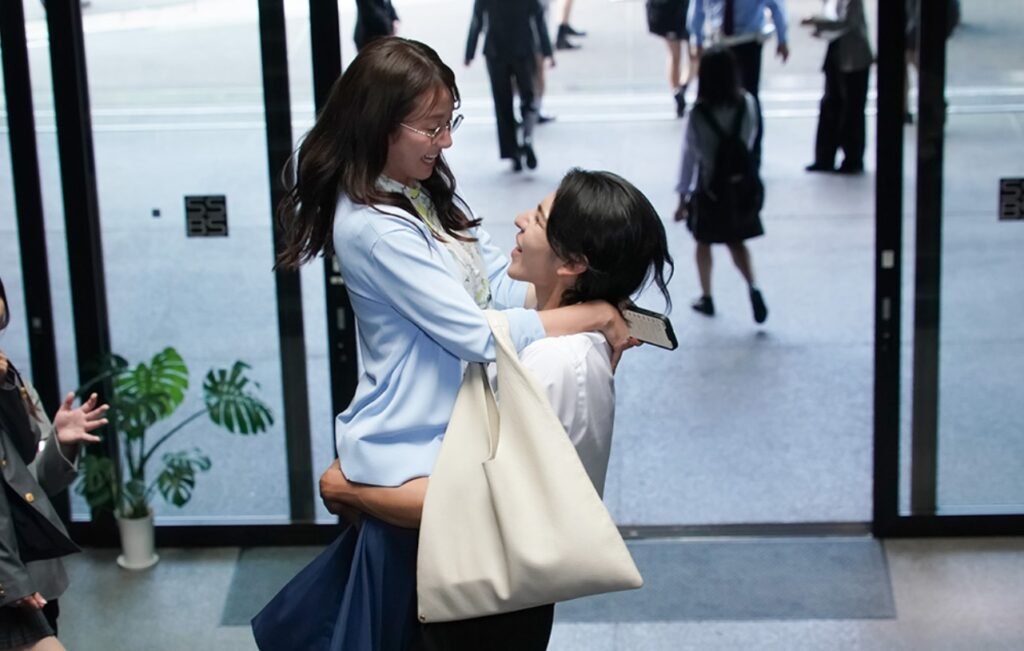
I chose the featured image, taken from Episode 6, rather than the drama poster, because I loved their outing so much when they could be themselves. That date is as if there is no tomorrow.
About the title “The Right Size Heart”. I will explain the phrase in the Review section below. Since, in this drama, I didn’t only learn about the dark Japanese host club industry, but also Kanji!
Drama Info
Drama title: Learning to Love (Native title: 愛の、がっこう )
Alternative titles: Ai no, Gakkou
Genres: Romance, Drama
Aired: Jul 10, 2025 - Sep 18, 2025
Episodes: 11 |  Duration: 54 min.
Directors: Nishitani Hiroshi ( 西谷弘 )
Screenwriter: Inoue Yumiko ( 井上由美子 )

Trailer: Kobayashi Chiaki @ Facebook (unofficial)
Where to watch: Netflix

OST: Spiral feat. Yura by Reini [YouTube link in the Review section)
Synopsis
Synopsis from Netflix
When a cautious teacher agrees to tutor a nightlife host who struggles to read and write, their growing connection sparks criticism and controversy. (Source: Netflix)
Synopsis from MyDramaList
The official synopsis from Netflix seems short and doesn’t really emphasize the uniqueness of this drama, so I added below the synopsis from MyDramaList, which piqued my interest in watching the drama after reading it. Although rather long, it only covers part of the first episode.
This is a love story about Ogawa Manami, a high school teacher who grew up in a strict family, and Kaoru, a host who is not good at reading and writing, as they search for love despite the obstacles they face. Manami is being pressured to marry a man she met through her father’s introduction, and the high school where she works is also facing a crisis of class collapse. She spends her days lamenting, “I want to run away from this place.”
One day, she receives a call saying that a student has been deceived by an unscrupulous host, and she rushes to the store to bring the female student back, where she meets Kaoru. Kaoru has to sign a promissory note promising not to contact the student in the future, and Manami finds out about the problem that he had kept secret from anyone until then. In the play, the two gradually become closer through Manami’s secret “private lessons,” in which she teaches Kaoru about language and society.
Characters
Main Characters

Kimura Fumino ( 木村文乃 ) as Ogawa Manami or Aimi
A 3rd-grade homeroom teacher at Pietas Girl Catholic High School. Aimi grew up in a family with traditional values and became a teacher at her parents’ urging. She’s struggled in love, although currently dating Kawahara Yoji, who was arranged by her father. He had proposed to her, but she’s unsure about her future and her marriage. Furthermore, at work, Aimi is unable to face rebellious students and unreasonable parents, her superiors, and colleagues. While she quietly tries to get away from everything, she suddenly meets Kaoru, and her world changes completely.
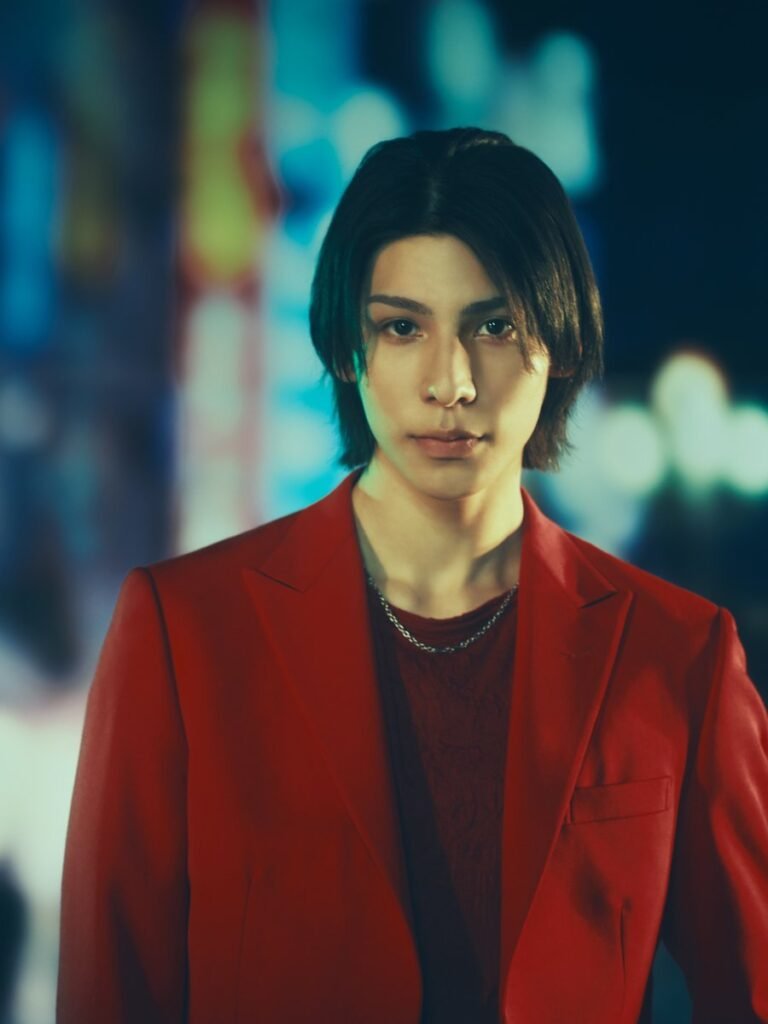
Murakami Raul Maito ( 村上真都ラウール ) as Takamori Taiga / “Kaoru”
A hosts working at the host club “THE JOKER”. His friendly smile and communication skills are used as weapons, and his popularity is rapidly increasing. He grew up in a poor family environment, and does not have a good relationship with his mother, Nao, and his father doesn’t even know what he looks like.
He rarely attends school and does not receive much compulsory education. He’s not good at studying, especially reading and writing Kanji.
Supporting Characters
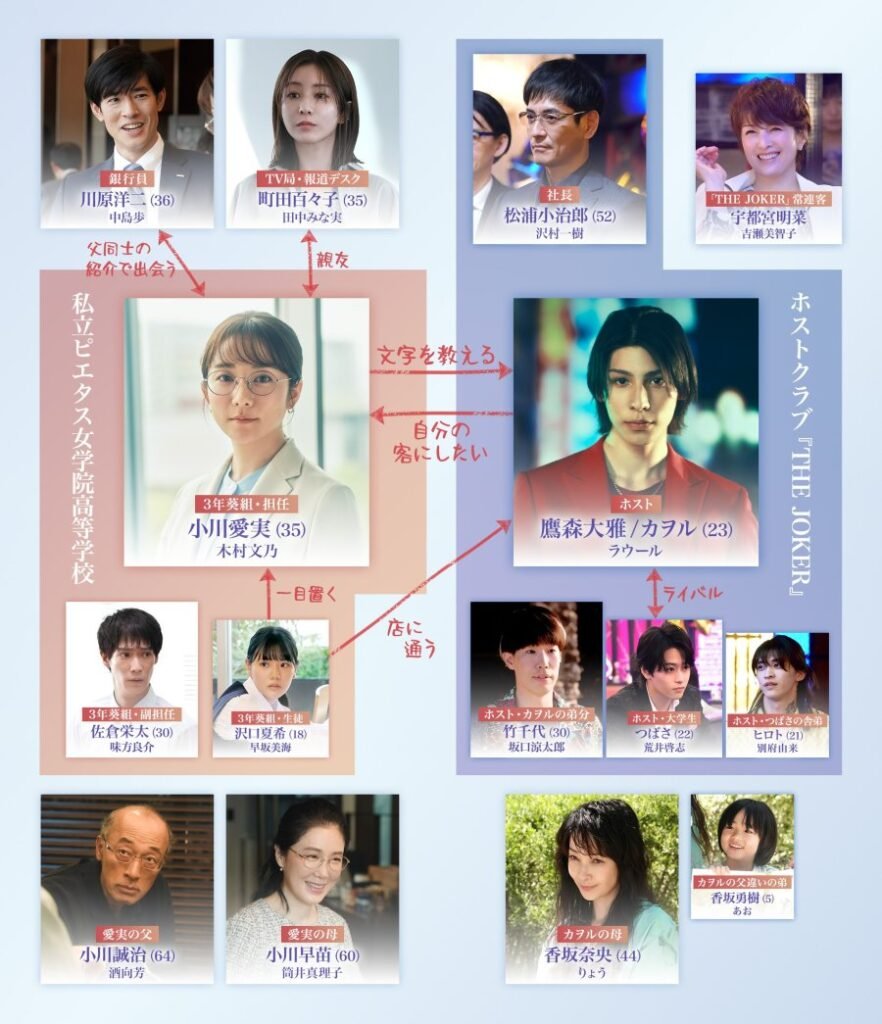
The supporting characters as shown in the relationship chart:
TOP:
- Kawahara Yoji (Nakajima Ayumu) – Aimi’s boyfriend
- Machida Momoko (Tanaka Minami) – Aimi’s bestfriend
- Matsuura Kojiro (Sawamura Ikki) – THE JOKER’s boss
- Utsunomiya Akina (Kichise Michiko) – THE JOKER’s regular client
BOTTOM (Row 1):
- Sakura Eita (Mikata Ryosuke) – Aimi’s colleague
- Sawaguchi Natsuki (Hayasaka Miu) – Aimi’s student
- Takechiyo (Sakaguchi Ryotaro) – Kaoru’s colleague and roommate
- Tsubasa (Arai Keishi) – Kaoru’s colleague, Host #1
- Hiroto (Beppu Yurai) – Kaoru’s colleague, Host #2
BOTTOM (Row 2):
- Ogawa Seiji (Sakou Yoshi) – Aimi’s father
- Ogawa Sanae (Tsutsui Mariko) – Aimi’s mother
- Kosaka Nao (Ryo) – Kaoru’s mother
- Kotoki – Kaoru’s half-brother
My Rating
My rating for this drama was based on MyDramaList’s scoring system, which is from 0.0 to 10.0. For any drama/movie/show I completed, I gave a minimum rating of 6.0 to appreciate the hard work of the production team, and to adjust to MyDramaList’s overall score base. From 6.0, this drama has additional scores of:
- 1.0 for the unique plot setting, which is a Japanese host club
- 1.0 for the unique character setup of Kaoru, who has dyslexia as an adult, and Kanji learning.
- 1.0 for the acting of the leading actor and the leading actress
My final rating was 9.0/10
I detailed my explanation as to why I gave such additional scores in the Review Section below.
Review
Story and plot
Story
The themes in this drama:
- Social and class divisions. The story highlights the vast differences between the affluent and privileged class and the marginalized and impoverished class in Japan.
- The host club industry. I will explain this theme in a special section below
- Healing from past trauma for both Aimi and Kaoru
- Character growth and self-worth. The plot centers on the personal development of the couple.
- Unconventional relationships between Aimi and Kaoru
- Emotional honesty vs. social performance. The drama contrasts the facades people wear for society’s sake with their genuine inner lives.
Plot
The romance in Learning to Love is portrayed as a slow-burning, realistic, and emotionally deep connection between Aimi and Kaoru, who face significant personal struggles. Their romance is not flashy, but rather emphasizes subtle character growth and shared understanding as Aimi and Kaoru overcome societal barriers, class differences, and personal conflicts to achieve a meaningful bond.
The Japanese host club industry
Learning to Love offers a nuanced portrayal of the host industry, exposing its dark side of financial exploitation while also highlighting the emotional toll and vulnerability of male hosts. It provides social commentary on issues like predatory practices and male victimization, which are often overlooked.
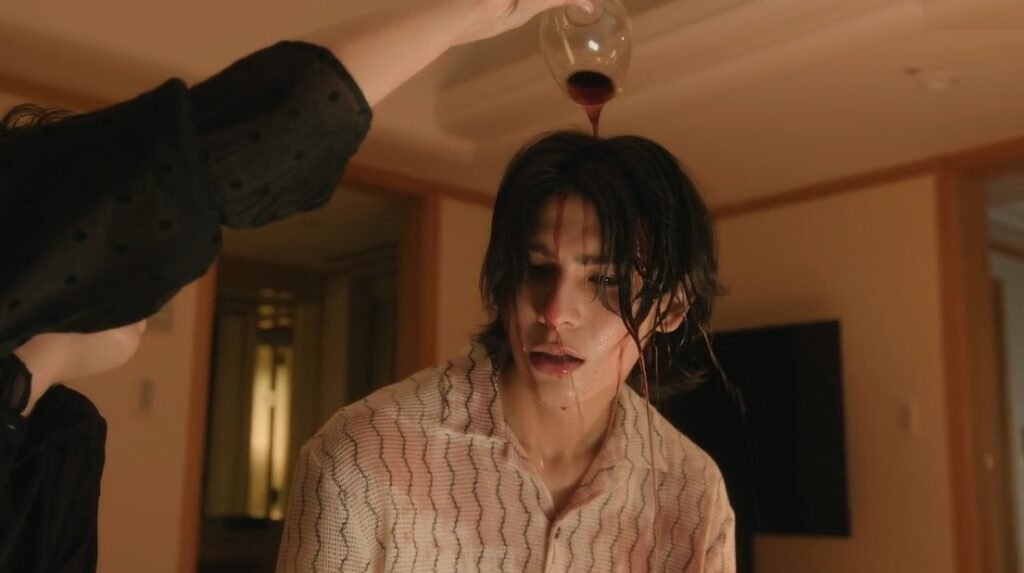
A customer poured a glass of wine to humiliate Kaoru
As I mentioned in the Introduction section, I have never watched any drama or movie on the Japanese host club industry. Although I’ve heard about it, but never really cared to find out about it since I don’t live in Japan. While watching Learning to Love, I did some online research about the industry. Some research results indicate that what is shown in the drama is true in the real world, for example: the sales competition between Kaoru and Tsubasa, the traps set to get customers to buy drinks, and what happened to Akina.
At the end of the drama, it was also mentioned about the regulation on the host club industry. In May and June 2025, Japan passed and implemented significant revisions to its Entertainment Business Law to crack down on predatory tactics used by some host clubs. The new regulations target coercive sales methods, false advertising, and the exploitation of female customers who were being pressured into sex work to pay off their debts
Acting and Characterization
I have never seen the leading actor and the leading actress before. I applauded Raul and Kimura Fumino’s acting in Learning to Love for their emotional depth and the authentic portrayal of complex characters. I was impressed by Raul’s phenomenal acting, effectively conveying Kaoru’s hidden emotions, vulnerability, and the weight of his past. Kimura Fumino had a compelling performance, showing care and evolving depth in her character.
Aimi is a high school teacher from a well-off family, while Kaoru is a host from a working-class background who struggles with illiteracy. She helps Kaoru learn to read and write, which, in turn, helps him rebuild his self-worth. In a role reversal, He helps Aimi to be honest and free, encouraging her to shed her societal facade. Their characters’ emotional depth comes from the character growth and how Aimi and Kaoru navigate their complex circumstances, rather than superficial romantic tropes. In the process, their romance develops gradually, grounded in the characters’ authentic emotional lives and real-world challenges. Their relationship is built on a profound emotional and intellectual connection, as Aimi and Kaoru see and understand each other in ways others do not.

Let’s talk about their acting. In my opinion, Raul’s acting was phenomenal and compelling, effectively conveying Kaoru’s hidden emotions, vulnerability, and the weight of his past.
Another characterization aspect in Learning to Love is that it is an age gap romance. Aimi is 35 and Kaoru is 23, to emphasize the societal pressure on her to get married, and the average age of hosts working in such an industry (in their early twenties). I don’t usually watch age gap dramas, and when I first watched the first episodes of this drama, I didn’t even notice a striking difference in age. Probably because the leading actor is very tall and the leading actress is petite in comparison. Raul is 192 cm or 6′ 3.5″ tall, and Kimura Fumino is 164 cm or 5′ 5″ tall. Kaoru even named Aimi “Chihuahua Sensei” in the first episode, because she scolded him, and her student told him that nobody listened to her in class. For him, she was like a yappy puppy, lol.
The second factor that seems to be reducing the age gap is their makeup. As a host, Kaoru puts on makeup. On the contrary, Aimi barely wore makeup (or no-makeup makeup). When I saw Kimura Fumino with full makeup in public, she looked way older than Aimi.
Despite the age difference, they have great chemistry, as shown in the scene below. So cute!
The portrayal of dyslexia
I have never watched a drama with dyslexia, especially in an adult. Kaoru’s struggles with reading and writing are not just a simple plot device but an integral part of his identity and his journey of self-worth. Learning to Love contrasts Kaoru’s confident, successful facade as a host with the intense pressure he feels to hide his learning disability. The drama also explores the societal stigma surrounding illiteracy and frames Kaoru’s learning disability as an obstacle that is tied to his trauma and vulnerability, rather than a flaw.
Aimi’s role as Kaoru’s tutor and love interest is crucial in shaping the drama’s portrayal of dyslexia. Her reaction stands in stark contrast to the societal judgment Kaoru has come to expect. Aimi treats Kaoru with patience and respect, never shaming him for his struggles. Her enthusiasm for teaching provides him with the kindness and non-judgment he has likely been denied in the past, causing him to fall for her.

The Kanji of “Love”
In the drama, Aimi says that the Kanji of “love” is difficult to write. The “heart” in the middle can neither be too big nor too small to write it beautifully. If you see the pictures below, the Kanji of “love” is on the left and the one for “heart” is on the right. The 7th, 8th, 9th, and 10th strokes form “heart”. The strokes have to fit under the 5th stroke and be aligned with the 11th, 12th, and 13th strokes.
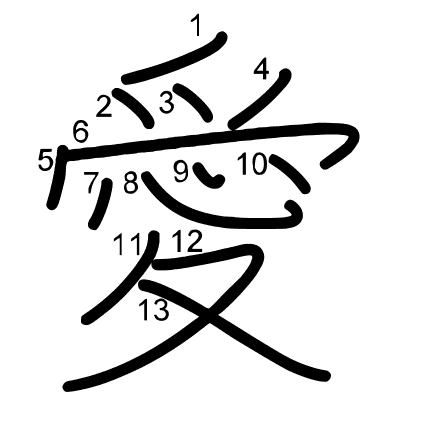

Therefore, the right size of heart is crucial for true love. It cannot be too big (giving love too much without receiving love equally) nor too small (receiving love without giving it, being selfish). Thus is the title of this article.
The Shooting Location
The only thing I want to mention for the visualization in this drama is the filming location in Episode 6 and Episode 11, Miura Beach, also known as Miurakaigan, in Kanagawa Prefecture, Japan. In the drama, Miura Beach is the site of a farewell trip for Kaoru and Aimi, where they visit a local shrine to write down their wishes. It’s also the site where they meet again. Their farewell trip was beautiful yet heartbreaking.
Miura Beach is a popular filming location for Japanese movies and dramas due to its exceptional accessibility from Tokyo and its calm, aesthetically pleasing scenery. On quiet days, the water is so calm it resembles a lake, providing a serene and picturesque backdrop for various scenes.

The Symbolism?
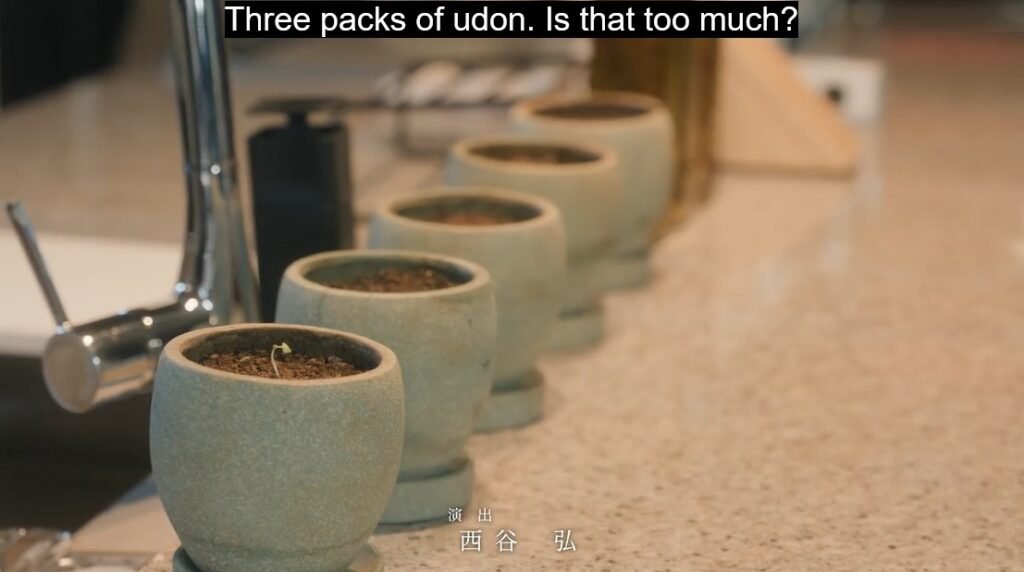
In the ending scene of the drama, when Aimi’s father takes out ingredients from the fridge to make noodles, I think there are two symbols.
Firstly, the camera panned to empty pots, with one pot growing a little sprout. Aimi’s mother used to plant mint, and when she was nervous, she would bite mint leaves to calm herself down. That one sprout may symbolize a new beginning.
Secondly, Aimi’s father also took out three packs of udon. Whatever he would cook wouldn’t be for his wife because she went to work. A pack of udon is usually enough for one person. Three packs of udon are for three people. So, perhaps Aimi and Kaoru would come to visit, and he would cook for the three of them? That may symbolize that her father finally accepted Kaoru. At least, they would bond over cooking for their women, lol!
Original Soundtrack
I don’t usually listen to Japanese OSTs, but I was drawn into the song used for this drama. I listened to it in a loop while writing this review. Reini wrote the song specifically for Learning to Love. The lyrics are a mix of emotional chaos, yet also convey a pure and delicate light of hope. The song tells about two lovers who are thrown into the conflict between reason and impulse. When they realize their loneliness and the inner contradictions within themselves, instead of denying them, they simply accept them as something to be cherished. The song is performed by the gentle and emotional vocals of Reini, accompanied by the soft voice of young singer Yura. Besides the lyrics, the catchy melody and duet of the two singers create an appealing contrast of harmony.
We’re both scared of the outcome, but that’s okay. Love isn’t easy.
FYI, Reini was invited to the shooting location, and he performed this song to Raul, Kimura Fumino, and the drama crew on the rooftop, where Aimi usually teaches Kaoru.
Conclusion
Learning to Love shows us that a sincere, emotionally honest relationship can bloom between two people from different backgrounds, even when society deems it inappropriate. Understanding and empathy are key to forming real connections. Believing in someone can have a transformative effect. For that to happen, it requires courage and the willingness to stand up for what you believe in. That’s true love.

Ending Spoiler
A period also indicates that you start a new sentence. [Spoilers on what happened to the characters]
After Kaoru failed the beauty school admission test, he was discouraged and broke up with Aimi. However, as stated above, a period is not only to end but also the start of a new sentence. There are new beginnings in the end. Aimi’s parents didn’t get a divorce and now have role reversals; her mother went to work, and her father became a househusband. Yoji moved to New York and said farewell to Aimi before deleting her contact number. Boss Kojiro no longer did business in the host club industry. As for Kaoru, he tried to go back to his old life, but he realized it was a fake happiness. Meanwhile, Aimi got another teaching job. Kaoru and Aimi met again at Miura Beach for the fireworks event, tho no fireworks scene. Kaoru was optimistic and would try the beauty school again.
Aimi and Kaoru, starting their romance on a clean slate, and on sand full of “love” (愛), after realizing they cannot be apart, and finding a mutual growth where they can “learn to love” in a way that is honest and real for them. Although their initial relationship was complex, it resulted in growth for both of them. The period break emphasizes that their journey as a couple is just beginning, and while they may face challenges in their future, they are committed to building a future together.



Thank you for such through details on this masterpiece. I still can’t move on from them. I’m 32 yo, and after thinking I’ve seen so many dramas since my twenties (Korean, Japanese, and Chinese) was so sure nothing can satisfy me anymore. Yet, this drama proved me wrong. There’s so many dramas that I’ve collected because their uniqueness. But for this one, I don’t know how to put my thought on it. It just beautiful and pure. I even imagine when I reach 50, this drama is something I had in plan to rewatch, so I can remember the cherish and happiness I felt like the first time experience.!
You’re right about the uniqueness, I think, because the drama has two leads, who are unique and unlike the typical leads in romantic dramas (occupation, social status, character, appearance, family background, etc). ML and FL are also different from each other; however, somehow, the romance works.
Just curious, what other dramas did you collect because of their uniqueness?
Thanks for reading and commenting on the article!
Well, I have 1TB hardsisk just for dramas. I bought it since 2012 and save the drama and movies I think worth to rewatch in the far far away future. The total probably 200 dramas and 100 movies there. If the drama just interesting enough to be watched one time only, I won’t take my effort in downloading and save them. Only the drama I found strokes me with particular line, wisdom, or left deep thought that deserves to be kept. Other times, the reason was because of the provided ost came out with such great music that brings comfort to my ears. 😅
If I have to devided into each country as far as I can remember for now, probably the list goes:
1. Korean (2521 Drama). My word for this drama, it’s painfully beautiful.
2. Chinese (My Boss 2024). I know it’s such a template idol drama with minimum conflict (but still bring some thinking). But the ost captured my heart the most. 😆
3. Japanese (our recent heartthrob Learning to Love). The reason I love it maybe because it against my well-known accepted thinking just like Manami’s mom said to Kaoru when she begged him to leave her daughter: being with someone who’s not a match only bring unhappiness. Yet, for the 11 episodes, it proved otherwise.
I am happy finding your website where someone loves and taking time to discuss the drama they cherish. What is your top three drama for now based on those same countries?
Wow… I wish I started watching Asian dramas a long time ago, as you did, but I only started in the mid 2019. Lol, it’s hard for me to decide which one is the best from each country because I’m basically a generous rater. If I must, then: 1. Korea: Tomorrow. 2. China: Eternal Love (2017). 3. Japan: Gannibal Season 2. These three gave me tears and drama withdrawals.
I see. Anyway, I will check your website from time to time on drama reviews. Perhaps one of them discussed a drama I also fell in love with. One final question, are we agree that Joker’s boss was indeed Kaoru’s father? And In the end, even though they did not epxlicilty show it, Kaoru finally realized internally that the man is his father?
What is your thoughts?
Yes, please do. Although some articles are recaps and highlights, I have also recently added mini-reviews to them (in the “My Rating” section, after “Characters”). They are in the first part of the article series, but I only completed the mini reviews after I finished the dramas, because the endings affect my ratings. If you want, you can subscribe, so you’ll get notified every time I publish a new article. I hope my preferences match with yours. What are your preferred countries/genres/tags/tropes?
Regarding this drama, I read in the discussion forums (MDL, Reddit, etc) that it was implied that the boss was Kaoru’s father. I’m not sure. I think I lost in translation, and the Japanese version may hint at it, which is why people mentioned it.