Introduction
When this most anticipated drama was dropped on 16 January 2026, I watched about halfway because of real-life activities, and finished it after the hectic weekend was over. I admit, while I hadn’t finished watching, my curiosity made me skim comments and reviews to find out about the ending and other people’s opinions. To my surprise, the drama received extremely polarized reviews. This drama was heavily promoted and expected to be amazing; many viewers felt disappointed as it didn’t meet those high expectations, leading to more critical reviews.
As for me, since I already got the ‘cheats’ from the comments and reviews of what to expect, I finished the drama with an understanding of some expectations. I would share them with you, since I think the knowledge leads to replacing incorrect ideas with accurate ones, which is crucial for enjoying Can This Love Be Translated?. Still, it doesn’t mean that after understanding the unmet expectation, you should rate the drama high or be satisfied with the story.
This is an editorial article, so, to caution the readers who haven’t watched the drama yet and have contemplated watching it: this article contains spoilers for specific subjects of discussion. It’s better to check the Table of Contents first, to read or not a particular section of the Unmet Expectations. The ending spoiler of the drama is given at the end of the article, if you are curious about it.
Since I love the visuals in this drama, some pictures in this article showcase the beautiful cinematography/shooting locations; they have no connection to the parts I discussed.

Drama Info
Drama title: Can This Love Be Translated? (Native title: 이 사랑 통역 되나요?)
Alternative title:  I Sarang Tongyeok Doenayo?
Genres: Romance, Drama
Aired: 16 Jan, 2026
Episodes: 12 |  Duration: 60 min.
Director: Yoo Young Eun (유영은)
Screenwriters: Hong Jeong Eun (홍정은) and Hong Mi Ran (홍미란)

Where to watch: Netflix
OST
Love Language (사랑의 언어) by Kim Min Seok (Melomance) 김민석 (멜로망스)
Dance Alone () by Zior Park (지올팍)
Promise by Wonstein (원슈타인)
Delight by Viola (비올라)
Round and Round by Jisokury
Good Bye by We Are the Night (위아더나잇)
Delight by Viola (비올라)
Round and Round by Jisokury
Waltz for Moon by Hodge
Someday by Siyeon (Dreamcatcher) 시연(드림캐쳐)
나란히 누워 (“Lay Down Together”) by off the menu
Bittersweet by Siso (시소)
Daydream by Wendy (웬디)
Your Words, My Heart by Hodge and Oh Ye Ju (오혜주)
Trailer
Synopsis
The emotions of a celebrity and her interpreter get lost in translation as they travel the world filming a TV show. Will love find its own language? (Source: Netflix)
Characters
Main Characters

Kim Seon Ho (김선호) as Ju Ho Jin
As a multilingual interpreter, which is rare even globally, Ju Ho Jin gradually became closer to Cha Mu Hee, a global top star, after taking on her interpretation, and found their interactions enjoyable.
He looks like the perfect guy, but he has a poor sense of direction and is a bit socially awkward.

Go Youn Jung (고윤정) as Cha Mu Hui / Do Ra Mi
Cha Mu Hui: An actress who rose to global stardom through a zombie role.
Do Ra Mi: A dancer character in the movie “A Quiet Woman” who was played by Cha Mu Hui.

Fukushi Sota (福士蒼汰) as Kurosawa Hiro
A Japanese actor who appears on the dating TV show “Romantic Trip” with Cha Mu Hui.
Due to the past incident with Cha Mu Hui at the Japanese film festival, he harbors a grudge toward her.
Supporting Characters

Sin Ji Seon (Lee Yi Dam) – TV Producer and the replacement PD for “Romantic Trip” show

Kim Yong U (Choi Woo Sung) – Cha Mu Hui’s manager
My Rating
My rating for this drama was based on MyDramaList’s scoring system, which is from 0.0 to 10.0. For any drama/movie/show I completed, I gave a minimum rating of 6.0 to appreciate the hard work of the production team, and to adjust to MyDramaList’s overall score base. From 6.0, this drama has additional scores of:
+0.5 for the main romance: the first part of the drama (the romcom), before the plot becomes convoluted after the genre ‘change’.
+0.5 for the acting, especially Go Youn Jung’s, who played two characters with different personalities.
+1.0 for the visually pleasing cinematography with diverse and beautiful landscapes of South Korea (Seoul), Japan (Kamakura, Enoshima), Italy (Tuscany: Siena, Florence, Perugia), and Canada (Alberta: Banff, Canmore, Lake Louise).
My final rating is 8.0/10.

Unmet Expectations
Unmet Expectation #1: Romantic Comedy
While the drama is primarily categorized as a romantic comedy (rom-com), starting in the middle of the drama, the genre changes to romance with drama. The plot starts with the meeting between Ho Jin and Mu Hui in Japan, and follows with them navigating love across communication barriers, with comedic situations arising from misunderstandings. In the middle of the series, the plot moves beyond standard rom-com tropes, into a more complex interpretation of mental struggles and past trauma. Later plot developments reveal deeper psychological themes, such as Do Ra Mi being a manifestation of childhood memories rather than just a simple “role,” which shifts the tone from light comedy to more serious drama.

First meeting and parting in Japan
Now, because it was promoted as a rom-com, it’s normal if people are interested in watching this drama because of the genre, not because of the actor/actress, synopsis, cinematography, or availability on Netflix. It’s simple. People prefer rom-coms over pure romance genre because rom-coms deliver wish fulfillment through comedy and feel-good scenarios, tapping into a desire for simple, satisfying love stories, which can be more appealing than heavier dramas that might focus too much on relationship struggles, making them emotionally draining.
While funny and romantic, the drama also has melodramatic and emotional layers, typical of K-dramas written by the Hong Sisters. Their scripts are well-known for quirky fantasy, witty humor (puns, meta-references), relatable yet strong female leads, and a unique mix of lighthearted romance that often deepens into heartbreaking, emotional territory, featuring memorable characters, unique worlds, and surprising twists that keep viewers hooked.
Unmet Expectation #2: Mental Health Issues
Hong Sisters are famous for blending genres in their K-dramas, masterfully mixing comedy, romance, fantasy, and supernatural elements with heartwarming or heartbreaking emotional arcs. In Can This Love Be Translated?, they dared to venture into the psychological element with Do Ra Mi.
Who Is Do Ra Mi?
At first, Do Ra Mi is the chilling zombie character Mu Hui played in her hit movie “The Quiet Woman”. However, later, Do Ra Mi became a terrifying alter ego, a manifestation of Mu Hui’s repressed trauma and self-doubt about love, blurring the lines between character and reality for Mu Hui as she deals with fame as a movie star and a new relationship with Ho Jin.
Do Ra Mi is an internal saboteur, appearing as hallucinations that evolve into a separate personality, sometimes taking over Mu Hui. While Mu Hui is guarded and indirect, Do Ra Mi is free, straightforward, and often disruptive, reflecting Mu Hui’s suppressed self.
Did Mu Hui had Dissociative Identity Disorder (D.I.D)?
No, at least, Mu Hui is not diagnosed as having D.I.D. by her psychologist (and Hong Sisters). Instead, Mu Hui is said to experience psychological distress that manifests as a delusion. Do Ra Mi is her psychological shield, which emerges when Mu Hui feels exposed, voices catastrophic possibilities, and justifies pushing people away. This mechanism is triggered by deep-seated anxiety, worry, fear, and a tendency to expect the worst-case scenario.
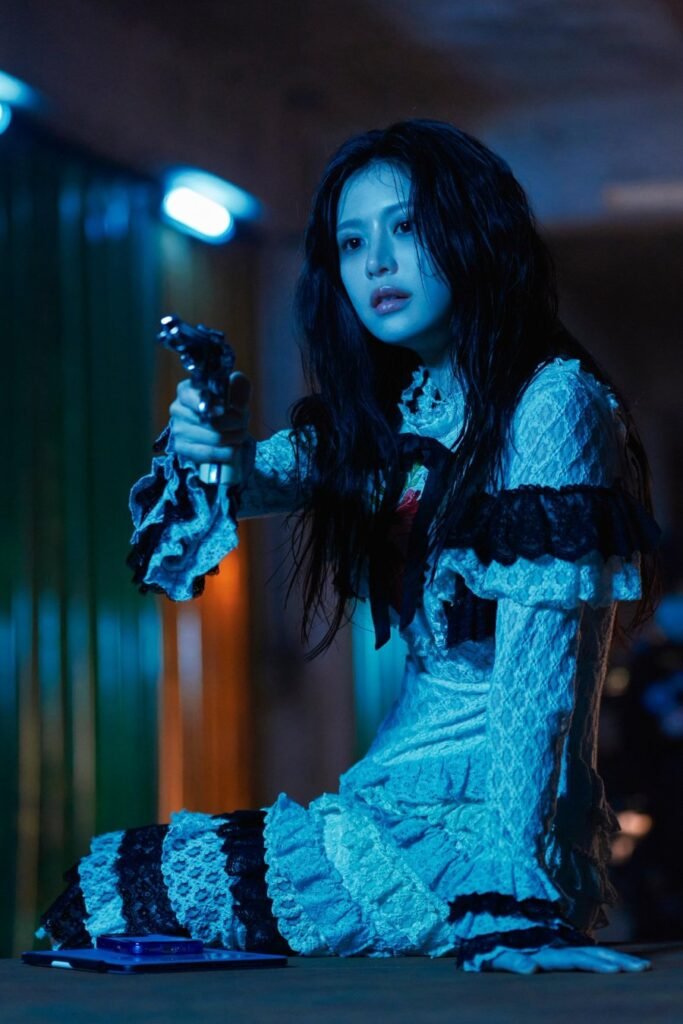
Do Ra Mi
What is Dissociative Identity Disorder (D.I.D)?
As a piece of information, D.I.D. is a type of dissociative disorder, which involves disruptions in memory, identity, consciousness, or perception, often as a coping mechanism for severe trauma, causing feelings of detachment from oneself (depersonalization) or reality (derealization). Besides D.I.D., other types are Dissociative Amnesia and Depersonalization/Derealization Disorder. Symptoms range from memory gaps and identity confusion to feeling outside your body, typically linked to overwhelming past experiences like abuse or neglect. All of these disorders are treatable mainly with trauma-informed psychotherapy.
Romanticizing Mental Health Issues
Either diagnosed with D.I.D. or not, Do Ra Mi at some point is Mu Hui’s alter ego. Dramas romanticize alter egos or characters with Dissociative Identity Disorder (D.I.D.) for sensationalism, creating drama through exaggerated traits like violent alters and dramatic switches, which drives viewership.
The concept of distinct personalities within one person lends itself to exciting, mysterious, and thrilling narratives, perfect for plot twists and character exploration. The symptoms are exaggerated, creating characters with aggressive or villainous alters, providing immediate antagonists, and driving conflict. Sensationalism sells rather than the clinical reality.
Unfortunately, many times dramas misrepresent the reality of D.I.D. as a subtle trauma response often involving secrecy and internal distress, not overt personality, leading to harmful stigma and misunderstanding. Most people with D.I.D. is covert, and they are no more dangerous than the general population.
The danger isn’t the topic itself, but when dramas use mental health only as a romantic trope, creating harmful illusions instead of promoting genuine understanding, which requires professional support beyond a dramatic rescue by a love interest.

Unmet Expectation #3: Short and Sweet 12 Episodes
The majority of viewers had two extreme opinions about content pace:
- On one side, many viewers concluded the 12-episode series dragged, particularly in the middle. Some argued the core story, the romance between Ho Jin and Mu Hui, could have been effectively concluded in 6–8 episodes. They regarded the subplots involving supporting characters as fillers.
- On the other hand, many viewers concluded that the 12 episodes are not enough. The drama attempted to juggle too many complex elements—including the female lead’s (FL) childhood trauma, a murder plot, and multiple love triangles—without giving them sufficient depth. The subplots and other characters besides Ho Jin and Mu Hui are also underdeveloped.

Hiro: For the sake of ‘love triangle’ plot device
In my opinion, both issues derive from one common source: “too much to do and not enough time”. Hong Sisters put too many subplots with too many supporting characters. Usually, writers do this due to excitement for ideas (fear of losing them), wanting deep immersion, or overestimating readers’ need for detail, leading to “info-dumps” and cluttered plots. I checked the Hong Sisters’ filmography, and this was their first time writing a script for a 12-episode drama, before they wrote at least a 16-episode drama, the traditional K-drama format to fit a complete story arc.
Netflix Original series usually have seasons with 8 to 10 episodes, though some dramas might have 13, and newer shows increasingly feature shorter runs of 6 to 8 episodes, prioritizing binge-ability and data-driven engagement over traditional longer seasons. In this case, I could not be sure if Hong Sisters were excited about too many ideas, were not aware that the final product was 12 episodes, or simply were asked by the production company (Netflix) to put a lot of subplots. If Netflix’s original production requirement for Can This Love Be Interpreted? is 12 episodes, I think the plot should be simplified.

Unmet Expectation #4: Netflix Translation
As I wrote above, Hong Sisters’ scripts are known for clever, fast-paced dialogue, humor, and meta-references that make their characters and situations memorable. K-drama viewers who have watched their dramas or know about their signature screenplays automatically look for this feature. Unfortunately, Netflix lost them in translation.
It is ironic that a drama with a main character who is a translator with a theme of communication has a translation issue. Some dialogues are not translated correctly, and some are not translated.
Netflix’s English translations for foreign dramas are often criticized as bad due to separate teams handling dubbing (lip-syncing focus) and subtitling (screen space/reading speed focus), language differences (idioms vs. literal meaning), tight budgets/deadlines, and cultural nuances getting lost, leading to mismatches, altered meanings, or awkward phrasing.
I read some viewers suggested using “English” instead of “English CC”. (Closed Captions). English CC is designed for the deaf and hard-of-hearing, including speaker IDs and sound effects, while the regular English subtitle option (sometimes called SDH or just subtitles) provides dialogue and focuses on readability for hearing viewers, often with slightly different phrasing or cultural adaptations, especially when translating from a foreign language. The main difference for general viewers is that English (CC) is a direct, literal transcript tied to an English dub, while the standard English option offers a more natural translation of the original language dialogue, making the standard English subtitle usually more accurate for foreign-language shows.

The Korean “arm heart” (팔 하트 = pal hateu). Despite the translation barrier, body language is still universal.
Conclusion
Since the start, the relationship between Ho Jin and Mu Hui has served as a vehicle for their healing. They allowed each other into their private worlds, both with their heartbreaks over their exes. Eventually, they found the strength to overcome individual anxieties and past emotional isolation.
Rather than viewing a lack of understanding as a failure, the drama portrays miscommunication as a natural part of developing intimacy. The ultimate message of this drama is that love must be felt through consistent actions like listening, supporting, and showing unconditional concern.
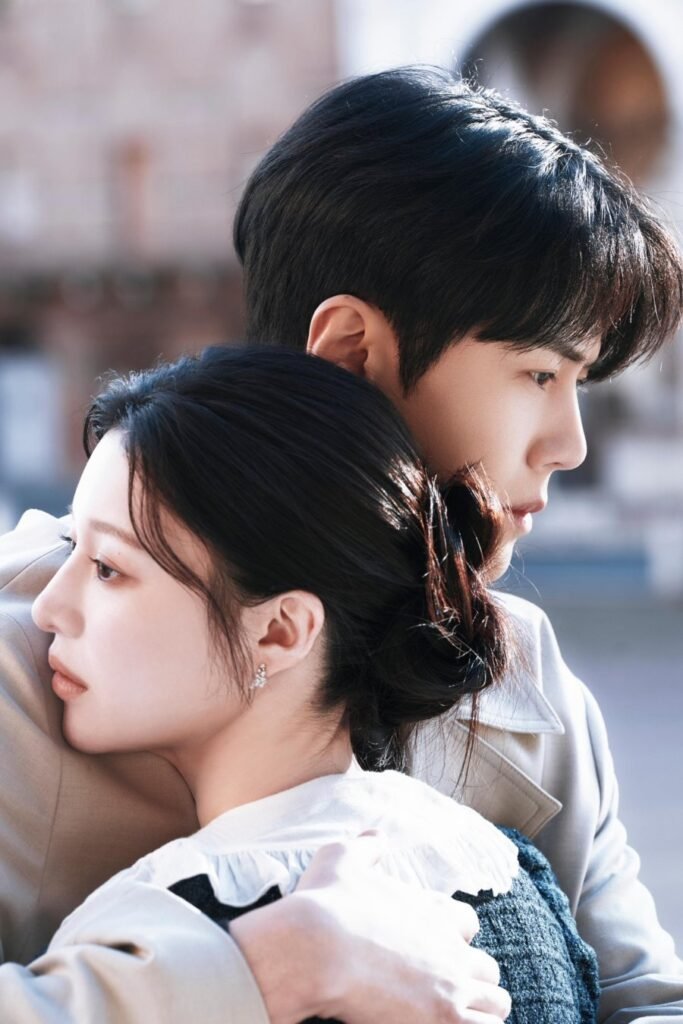
Extreme reviews happen because, in Can This Love Be Translated, viewers are either entirely captivated by the emotional roller coaster or completely alienated by the exaggerated storytelling.
At the end of this article, viewers’ opinions and reviews of dramas are
fundamentally personal and subjective. If you’re not a professional critic, your drama rating, opinion, and review are based on personal enjoyment, emotional connection to characters, and how the story resonates with you.
Ending Spoiler
What is the ending?
Happy ending, with no possibility of Season 2 (y’know the cliffhanger ending typical for Netflix productions).
How does the romance end?
Towards the end of the final episode, they broke up, not because of a misunderstanding or fight. Mu Hui wanted to find her mother to deal with her childhood trauma, without being dependent on Ho Jin. Time skipped, they reunited at the observatory, and the drama ended with a kiss.